
Monday, December 31, 2018
Tuesday, May 16, 2017
Gimmicks in Speaking - in Toastmasters and Real-Life

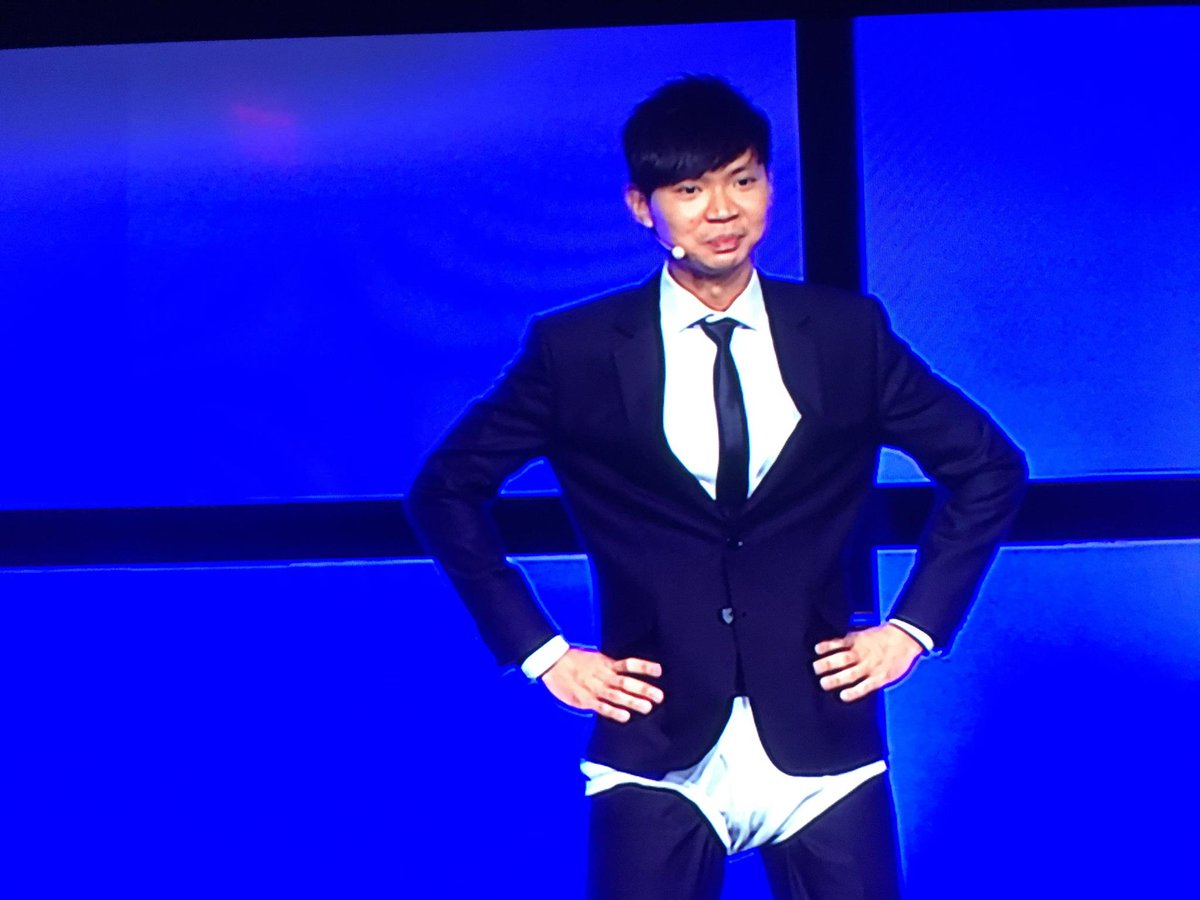
In 2016, the World Championship of Public Speaking (WCPS), a contest run annually by Toastmasters International, was won by someone who wore underwear over his suit pants for nearly the entirety of his speech. (An official video with excerpts is below - the full speech, illegally posted, can also be found, if you so desire). This brought gimmickry on the WCPS, stage to a new level - though whether that level is high or low, I'll let you decide.
Past gimmicks on this stage include, but are not limited to:
- Falling Down on stage, and speaking from that position (2001 Champ)
- Caressing a chair used to represent a relative who has passed on
- Asking the audience to stand and repeat a phrase to end the speech (I admit it - it was me)
- Standing on chairs, and using sign language (2003 Champ)
- Singing (2008 Champ, 1995 Champ)
- Music from a boom box while in a clown outfit
- Wearing a leather flight jacket (2010 Champ)
- Wearing jeans and a bolo tie (1990 Champ)
- Starting to light a cigarette on stage (2015 Champ)
- Discarding a rose into a trash can, later pulling a fresh rose out of it (2014 Champ)
- A 57 Word Title (2016 Runner-Up)
There are more - many more - if you know of one, post it in the comments. These are just the most memorable to me. Obviously, the gimmicks from Champs are going to stand out a bit more, in general. And it is those very gimmicks that tend to promote further gimmicks, bigger gimmicks, in subsequent years, ultimately (at least so far) leading to whitie-tighties bringing home the trophy.
The word 'gimmick' is a bit loaded with, perhaps, needless negativity. The 3-point shot in basketball was a gimmick. The Golden State Warriors have done pretty well with that one. Remember, too, that the slam-dunk was at one time considered not much more than a gimmick. Gimmicks in advertising, music, movie-making, even teaching school, make for an attention grabbing situation. When used well, within a larger landscape, it is both entertaining and effective.
When the gimmick outweighs the vehicle bearing the gimmick that it becomes, to me, less than desirable, less than effective, and downright annoying. When a gimmick becomes over-used - copied by others for the sake of copying - it's unbearable.
To bring this back to speaking, think about this: if you tossed your gimmick entirely, would the speech still work?

If Darren LaCroix, in 2001, didn't fall down in his championship speech, the entire speech would have had to have been reworked. He's known as much for falling down, for saying 'Ouch', as for anything else in that speech. In his case, the gimmick was an integral part of his speech, and was a gimmick only because it really hadn't been done before. One might say that as opposed to using falling down as a gimmick, he simply used the floor as a prop.
In Jim Key's 2003 winning speech - he stood on chairs. In my opinion, if you took this out of his speech, his speech still would have been a winner. Maybe it counts as half a gimmick. The sign language, however, was a stroke of genius gimmickry that made him stand out in both delivery and emotional impact. Again, a gimmick only in that it hadn't been seen.
In 2006 - my own gimmick of getting the audience to stand and yell with me probably stood out to many as just that. I'm not sure if it cost me a victory, or boosted me to my 3rd place finish.
Indeed, most gimmicks haven't been that bad. Or, maybe they've just become accepted and expected.
I would suggest that Darren Tay's gimmick in 2016 was unnecessary. That his speech would have been just as effective if he's shows them briefly (pun intended) and moves on, perhaps bringing them back at the close. Ironically to me, his coach had at one time told me that a prop should come out for a purpose, and then be put away so as not to distract. Perhaps said coach has changed his mind since then, or perhaps Darren ignored him. Yes, the speech would have had to change in its structure a bit. But the point would have been the same. The stories wouldn't have changed. Perhaps, he wouldn't have still WON, since the 2nd place speaker also used a gimmick (57 word title).
Perhaps it is WINNING, indeed the contest itself, that is inherently, the problem.
Would Darren have WON without the underwear? Would Jim have WON without the chairs? Would I have WON if I had left OUT the Standing up and Shouting? It's the winning that tends to drive the decisions. The desire to out-do, out-perform, out-surprise the other speakers in order to stand out that makes gimmicks acceptable, perhaps even NECESSARY at this stage of the contest. The drive for the trophy brings us to pull crazy stunts, perhaps in place of true creativity.

But overall, I don't see many professional speakers relying on gimmicks to carry their speeches. This is in part, perhaps, due to a longer format - even 20 minute speeches in the TED format are almost 3x as long as a Toasmasters speech. Most keynotes are 30 to 45 minutes long. Professional audiences aren't necessarily mesmerized by gimmicks unless you're already billed as a performer/speaker (magic, juggler, dancer, singer), and in fact, have been known to be turned off by such dramatics.
As we go forward this contest season, lets be judicious in how we use gimmicks, as well as how we receive gimmicks. Know why you're using them, know why they are important to your audience, know whether or not you really need them. Are they just the hoped for extra points on the ballot, or are they the integral aspect that drives your point home? Do they ADD TO, or DISTRACT FROM your message? Is your gimmick all that you will be remembered for?
As you go forward, speaking in the real world, don't mistake it for the Toastmaster world. Going over-the-top with gestures, costuming, even wordplay, can cost you credibility. It's a whole new stage out there, outside the supportive walls of TM, outside the slam-bam 5-7 minute speech format.
Remember, no matter how many 3-pointers you shoot, the game can't be won without the fundamentals - layups, mid-range jumpers, and free-throws. How balanced is YOUR speaking game?
(Editor's Note) This blog isn't intended to besmirch any Champ, or even Toastmasters in general. I love the Champs, I love TM. Every winner earned it. They did what they wanted to do, what they had to do. This blog, much as my entry last August, is about understanding what is important in speaking - about our motives and how we choose to impact the audience as a higher goal than the goal of winning a trophy. Not everyone can win the trophy. But everyone CAN win the audience.
(Editor's Epilogue) I intended to write this as a follow up to my blog about the 2016 World Championship of Public Speaking - a post that garnered a ton of attention, both positive and negative, and really super-charged the reach of Speak & Deliver. Like any good marketer/blogger, I promptly, if unintentionally, abandoned the blog entirely. But if you're reading down to this epilogue, know that I intend to be back on a regular basis, and a book will be forthcoming.
Tuesday, August 23, 2016
2016 World Championship of Public Speaking - A Serial Contestant's Perspective
First - a couple of caveats:
1. I did not coach, nor did I even know, any of the Finalists this year.
2. I did compete, but took 2nd at District. For the first time ever.
3. I have competed in the Semi's eight times, the finals twice, taking third in 2006.
Second - a blanket statement:
All finalists are great speakers. All went through the wringer to get there. All gave excellent presentations, and were worthy of being there.
Now, for the 'Perspective'...
Speech contests, and contest speeches, are curious constructs.
Judged anonymously by relative amateurs of varying experience and personal speaking ability (some world-class, others working-class, and occasionally, other should-go-back-to-class), the contestants face bias and subjectivity, combined with the unknown factors of who their judges are demographically and ideologically, and it can feel like an impossible task.
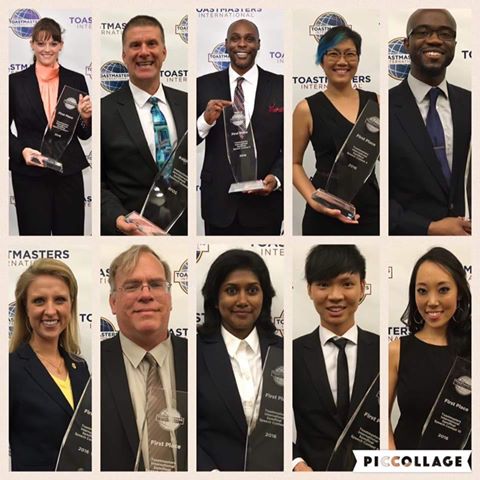
I know this sounds a bit pejorative and sarcastic, but it's truth. The playing field is pretty even for all - so no unfairness is implied. Themes of the human condition are used because they reach the most people. Tony Robbins often says 'success leaves clues' - and the speech contest is full of detectives picking up on what has worked before, so we, more often than not, get served the same messages, in very similar packages, despite the vast diversity of speakers delivering them.
The 2016 World Championship of Public Speaking surely was an impossible task - to compete in, and to judge. It showed all that is great about the contest and the Toastmasters organization, as well as all that is, occasionally, expected and traditional.
I'm going to stay positive in this review, much as I want to be critical here and there.
Katina Hunter - An Audience of One. Great chess story, excellent use of short young child vs. tall older child, and the ability to make herself the hero of a story without coming off as arrogant.
Donald Crandell - clearly had fun on stage, kept it light, Live With It message was a unique concept. Nice amputee soldier story at the end. Makes me wish my fake leg with help me climb mountains. I think I need an upgrade.
Elliott Eddie - one of my favorite topics - Give Yourself Permission. Interesting story about wanting to be a filmmaker and his supportive wife.
Kim Kaufman - owned it. Went all in on GPS and the concept of Recalculating - a speech I've almost written myself a few times. Clearly excited about her experience, and her message. Strong close.
Sherwood Jones - as a fellow comic book geek, I definitely connected with his opening. Personal Connection message was important and timely. Good humor, and extra points for working in PokemonGo.
Kaishika Rodrigo - Loved her pacing and vocal variety. Concept of Chiseling Out Your Masterpiece is another message I've almost used in the past. The whole 'the statue is in the marble, waiting for you to release it' is intriguing. She showed real joy as she spoke.
Josephine Lee - 3rd Place - now this young lady knows who she is. She played up the California girl in a way that made it endearing when it easily could have been annoying. Her humor and timing was spot on, and contrasted well with her closing revelation about her friendship.
Aaron Beverly - 2nd Place - forever to be remembered as '57-word-title-man', his message that talking a lot doesn't equate to saying a lot was truly original for this venue. Lots of energy, great 'Bus Lady of Doom' story, and excellent delivery almost launched him into first place.
Darren Tay Wen Jie - 1st Place - Captain Underwear. Literally put tighty-whiteys on over his pants for the majority of his speech. Took the concept of bullying from external to internal, a theme I have used repeatedly over the years. Grabbed our attention, offered a twist ending, tremendous humor. A worthy champion.
Now - here's where I may tick some people off. The person I wish had won:
Thien Trang Nguyen Pah - her theme of subtle domestic abuse was certainly 'out there' for this contest, just as her 'body image' theme in her semi-final broke the mold. She was emotionally open without being manipulative. The speech was crafted well, in structure, word choice, and staging. She even got a huge laugh in the middle of a tough, tough speech. To me, no other speech approached the 'professional speech' level of this offering.
Now, I say this without wanting to take anything away from any other contestant. And with full knowledge that this is my opinion, and will likely be met with opposition.
I understand why she didn't win, or even place:
- first speaker
- heavy theme that made people feel uncomfortable
- theme that may have not been received the same by the diversity of cultures
So, sure, it makes sense. But for my money, she was the best speaker, with the most important message, delivered in the most professional way. She didn't need gimmickry. She didn't need a laugh every 12.5 seconds. She didn't have to ask us 'Have you ever....' a million times. She just had to be authentic, identify the problem, touch our hearts, and offer a solution.
I understand why the Top 3 were the Top 3:
- humor
- memorable gimmicks
- energy
- universal messages
Hey - they were ALL great, and all of them had an argument for the Big Trophy. For what it's worth, my wife had Darren picked all along. In fact, everyone has their favorite, and no champion is ever unanimous.
My takeaway for Toastmasters today, however, is this:
How long are we going to allow the same formulas, the same message types, the gimmicks, to overwhelm true professionalism?
I regularly hear that 'no one would use a speech contest speech in real life', and when I show the championships to outsiders, they laugh at how 'over the top' we are. Is this who we want to be? Is this the type of speaking we want to promote? Darren, all the rest, and even myself must be forgiven for allowing ourselves to fall into this formulaic way of speaking - and even the judges must be forgiven for voting for it - because it IS what it has ALWAYS been for so long. Success leaves clues. Unfortunately, it doesn't always lead to GREATER success. And isn't that what we should be striving for in our crown jewel contest?
Thien, if you ever read this, know you are a champion in this speaker's eyes - and, trophy or not, I hope you Win Anyway as you go out into the world to Speak & Deliver the most important messages of all.

I hope our beloved contest, as well as our organization, continues to grow as well.
Monday, April 18, 2016
The Epic Keynote - a Review

I like Atkinson's style in general, and her book 'The Wealthy Speaker' is a great guide for beginners. Diving in this book, I was searching for a great keynote 'formula' that would make me look at what I'm doing in a whole new way.
What I got was the same old structure I always get, in the most simplified fashion possible.
Doesn't mean it's bad, however. In fact, it's filled with anecdotes from other speakers, almost to a fault. Atkinson seems more intent on compiling wisdom than chronicling her own.
The book covers a bit of old ground from The Wealthy Speaker, helping the reader identify the type of speaker they want to be, and who they should target. Then it hits the big topics - content, humor, style. It also talks about technology, storytelling, speaker's bureaus, and other ancillary aspects of the business, including finding a coach.
I did enjoy reading 'Tips From the Masters' and 'Flashpoints' from Mark Sanborn, Joe Heckler, Patricia Fripp, Darren LaCroix, and many, many others. I also found David Leiber's storytelling formula helpful.
It's easy to read, filled with short bits of accessible wisdom. If I'd picked it up 15 years ago, I'd be really impressed with it. If you're at the beginning of your journey in speaking, this is a great book for you. Just because it fell short of my likely too high expectations doesn't invalidate its content.
2 1/2 out of 4 Stars
What I got was the same old structure I always get, in the most simplified fashion possible.
Doesn't mean it's bad, however. In fact, it's filled with anecdotes from other speakers, almost to a fault. Atkinson seems more intent on compiling wisdom than chronicling her own.
The book covers a bit of old ground from The Wealthy Speaker, helping the reader identify the type of speaker they want to be, and who they should target. Then it hits the big topics - content, humor, style. It also talks about technology, storytelling, speaker's bureaus, and other ancillary aspects of the business, including finding a coach.
I did enjoy reading 'Tips From the Masters' and 'Flashpoints' from Mark Sanborn, Joe Heckler, Patricia Fripp, Darren LaCroix, and many, many others. I also found David Leiber's storytelling formula helpful.
It's easy to read, filled with short bits of accessible wisdom. If I'd picked it up 15 years ago, I'd be really impressed with it. If you're at the beginning of your journey in speaking, this is a great book for you. Just because it fell short of my likely too high expectations doesn't invalidate its content.
2 1/2 out of 4 Stars
Thursday, March 31, 2016
5 Ways to Approach Conflict (without ending up with a Kryptonite spear in your chest)

So I loved it, for the most part. Still, one aspect really bugged me, as a communications coach.
***SPOILERS BELOW***
When the big promised battle between Bats and Supes is about to begin, it's because Luthor has manipulated the two. He's convinced Batman that Superman is a menace, and kidnapped Superman's mom, telling our hero that unless he kills 'The Bat' she will die. Darn those super-villains!
The face-off starts promising enough. Superman tells Batman he needs his help. As he steps forward, he triggers a booby trap of hail and ice bullets. Pushing through that, instead of asking again, or, heaven forbid, telling him WHY he needs his help (Bruce, we need to save my MOM!), he pushes him across the roof, and a 10 minute battle ensues before Lois walks in and cooler heads prevail.
I understand they had to fight - it's the selling point of the movie. But c'mon. Two top-notch heroes fighting because they can't even communicate? Terrible.
While most of us will never be in the middle of a literally earth-shattering conflict, most any conflict can feel that way to us when we're in the middle of it. Our egos, our relationships, our livelihoods are often at stake - or at least FEEL as if they are at stake.
5 Ways to Approach Conflict
1. Set boundaries, expectations, and outcomes for the conversation.
2. Be willing to try more than ONCE to get your point across, before resorting to anger.
3. Disarm your 'opponent' emotionally by letting them know you understand their side of the conflict.
4. Avoid becoming overly defensive OR offensive, which takes you both off point, and into an emotional state that is harder to control than an objective state that focuses on the actual issues.
5. Bring in a third party to arbitrate/defuse the tension.
If you're headed into a potentially contentious discussion with peers, clients, competitors, or even your boss, you'll want to avoid having it end with a Kryptonite spear plunging into your chest.
In the meantime - go take a kid to BvS - cause I really want more movies. After that, go Speak...& Deliver!
Monday, March 7, 2016
You've got to MEAN it!
Last month, I was working with my wife as she practiced her keynote speech for BCNF - a Neurofibromatosis Awareness group in British Columbia.
Kristi is NOT a speaker. Well - she is, and she could be, and sometimes she even WANTS to be - but she's a wife, a mom, and in management at Colorado's largest movie theater - NOT a speaker.
Still, she's a celebrity in the NF world. She writes a popular blog, we put together a book for her a few years back, and she's dedicated to both creating awareness and educating doctors, parents, and children about the disorder that affects her and three of our six kids so directly.
As she prepared, she knew she wouldn't be able to memorize her speech. Instead, she's more of a 'lively reader'. She's worked hard to create a very authentic script - which is a lot harder to do than it sounds. Yet, every time she'd read it, I'd have to push her to really wring the emotion out of it.
"You've got to MEAN it!" came out of my well-meaning mouth more than once.
That's a huge lesson for all of us as speakers, whether we use notes or slides, or whether we read our speeches, or even can rattle it off verbatim each time without help at all. It's not just the words we say, it's the emotional meaning we give to them.
Kristi certainly MEANS everything in her speech. It's intensely personal, and designed to connect with and uplift her audience. It has humor, pathos, irony, anger, and triumph - all drawn directly from her real life. The obstacle is more often translating that meaning from the page via our voice inflections, pacing, and volume.
Tips for MEANING what you say:
1. Write the way you Talk - it's easier to be authentic when you deliver conversational phrases vs. well hone prose.
2. Record yourself - you might THINK you sound like you mean it, til you hear yourself say it.
3. Use Note CARDS - with bullet points to remind you where you're going, vs. letting yourself go through the speech solely via the script. Imagine trying to get somewhere new by car looking only at your GPS screen!
4. Highlight Emotions - with a real highlighter - different colors for different emotions, just to trigger yourself when you see it.
5. Get coached - or at least have a neighbor spray you with a water bottle everytime you slip into monotone.
When you MEAN it, the audience FEELS it. When they FEEL it, they remember it, and they are much more likely to act on it - which is, after all, the whole reason you're up there, right? To Speak...and Deliver!
I've attached her speech below - I think she's getting it ;)
Kristi is NOT a speaker. Well - she is, and she could be, and sometimes she even WANTS to be - but she's a wife, a mom, and in management at Colorado's largest movie theater - NOT a speaker.
Still, she's a celebrity in the NF world. She writes a popular blog, we put together a book for her a few years back, and she's dedicated to both creating awareness and educating doctors, parents, and children about the disorder that affects her and three of our six kids so directly.
As she prepared, she knew she wouldn't be able to memorize her speech. Instead, she's more of a 'lively reader'. She's worked hard to create a very authentic script - which is a lot harder to do than it sounds. Yet, every time she'd read it, I'd have to push her to really wring the emotion out of it.
"You've got to MEAN it!" came out of my well-meaning mouth more than once.
That's a huge lesson for all of us as speakers, whether we use notes or slides, or whether we read our speeches, or even can rattle it off verbatim each time without help at all. It's not just the words we say, it's the emotional meaning we give to them.
Kristi certainly MEANS everything in her speech. It's intensely personal, and designed to connect with and uplift her audience. It has humor, pathos, irony, anger, and triumph - all drawn directly from her real life. The obstacle is more often translating that meaning from the page via our voice inflections, pacing, and volume.
Tips for MEANING what you say:
1. Write the way you Talk - it's easier to be authentic when you deliver conversational phrases vs. well hone prose.
2. Record yourself - you might THINK you sound like you mean it, til you hear yourself say it.
3. Use Note CARDS - with bullet points to remind you where you're going, vs. letting yourself go through the speech solely via the script. Imagine trying to get somewhere new by car looking only at your GPS screen!
4. Highlight Emotions - with a real highlighter - different colors for different emotions, just to trigger yourself when you see it.
5. Get coached - or at least have a neighbor spray you with a water bottle everytime you slip into monotone.
When you MEAN it, the audience FEELS it. When they FEEL it, they remember it, and they are much more likely to act on it - which is, after all, the whole reason you're up there, right? To Speak...and Deliver!
I've attached her speech below - I think she's getting it ;)
Friday, January 8, 2016
Toastmasters Friday: What Makes A Champion? - Guest Post by Sharookh Daroowala

What Makes A Champion
Snapshots from the World Championship of Public Speaking - 2015
Perhaps no art form is as deeply transformatory for the performer and the audience as motivational speaking.
Little wonder then that there is always a huge buzz within the Toastmasters world when it comes time, annually, to select and crown the newest World Champion of Public Speaking. In this year-long duel, 35,000 contestants from 14,650 Clubs in 126 countries vie to be the last one standing after 6 rounds of grueling competition.
There has to be something intoxicating and awe-inspiring in just the title at stake: World Champion of Public Speaking! Or perhaps, these contestants dream of stepping into the big shoes of their idols, former Champions, who have gone on to achieve even greater glory after being crowned. After all, the performances and stories of many Champs have become the stuff of legend. Mark Hunter (2009) won from a wheel-chair. Dana LaMon (1992) was blind. Craig Valentine (1999) grew up with a pronounced lisp and is one of the world’s top speech coaches today.
In the past few years, as new Toastmasters Clubs and growth have burgeoned outside North America, primarily in Asia, there has been a growing number of contestants and contenders whose mother tongue is not English. This trend has resulted in many contestants, even Champions, speaking with distinct accents and imperfect grammar, pronunciation, diction and enunciation. Going by the results though, it’s apparent that Judges and the audience still believe that content and delivery are King.
As I watched this year’s Finals in Las Vegas, I was struck by the fact that all ten contestants were men. Yes, again! Half of them were from Asia, including the Top 3. Only 3 speakers had a recurring foundational phrase (such as “I See Something In You” so memorably used by the 2014 Champion, Dananjaya Hettiarachchi). A majority did not tell a formulaic Before and After personal story. And most strikingly, some speakers spoke to persuade rather than to inspire.
As a contest buff, student and teacher of the craft, I have observed that first-rate contest speeches usually contain the following “essentials” or checklist:
1. a single, simple uplifting message centered on a universal truth
2. personal story of despair and reinvention with sharing of lesson(s) learned
3. a foundational phrase: a recurring, memorable catch-phrase that speaks to the message
5. connection with audience
4. humor
6. emotional/reflection pieces and A-ha moment(s)
7. audience-focused language and
8. selling of the result - or applying the message - and the call-to-action
Just as the 8th contestant is about step on stage, the person flanking me asks me who my Top 3 choices are. On a complete lark and half in jest, I say “The 3 contestants we have yet to see”. For once, I got it right!
Contestant # 8 is Aditya Maheswaran from India with his speech “Scratch”. Still very young, he had already competed in the 2014 Semi Finals in Kuala Lumpur. His youth and exuberance are apparent from the outset. He grins nervously as the Contest Chair mangles the pronunciation of his surname but he wastes no time demonstrating the essentials: a personal story about misplaced priorities; how he gets upset when his new car gets scratched, and off-loads his frustration on others especially his girlfriend and his mother.
He learns his lesson only when the unlikely guru, a mechanic that easily fixes the scratch on the car tells him “a scratch stays only as long you don’t polish it”. As the penny drops, he gives his mother a hug, gets two back in return and by showing contrition and remorse, wins his girl back. Clearly he has entertained and regaled the audience with his simple, sweet and sincere story and message of mindfulness.
Contestant # 9 is Manoj Vasudevan of India/Singapore. His speech title and foundational phrase is “We Can Fix It”. Déjà vu! His speech is also about new love, pain and redemption. He too stays true to the essentials. The audience instantly warms up to him when he clarifies to much amusement that regardless of the commonalities with Aditya’s speech, his girlfriend’s name is not the same (as Aditya’s girlfriend). This spontaneous use of the call-back technique is as impressive as it is effective. Using the metaphor of how a bow and arrow works in tandem for a common cause, he cleverly and pictorially summarizes his point: by pulling less and bending more, you can “fix” any relationship problems.
Manoj’s message of tolerance and flexibility in a relationship and his inter-action with the audience makes him too a solid contender.
The final contestant is Mohammed Qahtani from Saudi Arabia. Aditya and Manoj have set the perfect stage for him. The audience is feeling rewarded and entertained by their light, romantic stories of personal reinvention. Will Mohammed deliver even more or has the new Champion already been minted?
What happens next may go down in Toastmasters history as one of the most memorable openings ever witnessed on the Finals stage. Nonchalantly Mohammed starts his speech by looking down and pretends to light a cigarette. By doing so, he cleverly manages to get the audience to say the first word in unity: “No”. As soon as he looks up and asks incredulously “What?” the house erupts with bellows of laughter. Mohammed has likely won the title with his first word. The Crown is his to lose. And he does not disappoint with his speech The Power of Words. Watch this opening clip and judge for yourself:
In addition to this seminal opening, Mohammed charms the audience with classic facial expressions matched perfectly with tongue-in-cheek humor, carefully timed pauses and impressive mimicry.
Although the narrative depth of his stories and his articulation were perhaps a drag on his scores, there is no arguing that he delivered his applause lines with theatrical dexterity and from the get-go, had the audience in the palm of his hand.
All three contestants are in the hunt for the big trophy. Ultimately the Judges pick Mohammed, Aditya and Manoj in that order. To the extent there was any doubt on that outcome, what happens next makes the Judges look even more golden and Mohammed a compelling choice as a worthy champion.
In his acceptance speech, Mohammed reveals that he was born mute and spoke his first words only at age 6. Think about this! A person born mute becomes the World Champion of Public Speaking by speaking about the Power of Words! And even more commendable, he never taps into the sympathy vote by disclosing this background in his speech. This is the stuff that Champions are made of!
Mohammed’s speech will not be remembered for its inspirational heft, big promise or storytelling brilliance. But it will never be forgotten because of its teasing opening and a strong connection with the audience. The real story though will be a much more memorable and uplifting one. It will be the enduring story of a speaker who transforms himself, first by being able to speak at all, and then by conquering the world with the power of his words.
As World Champion of Public Speaking, life will never be the same for one Mohammed Qahtani from Saudi Arabia. And for countless others, especially those with speaking disabilities, Mohammed’s achievement will be a spur and a springboard for their own transformation.
What greater purpose is there to hold speech contests than their proven propensity to change lives?

Subscribe to:
Posts (Atom)
LinkWithin
